EN
EN



Thermal Lamination Film Process vs. Water-based Lamination: Which is Better?
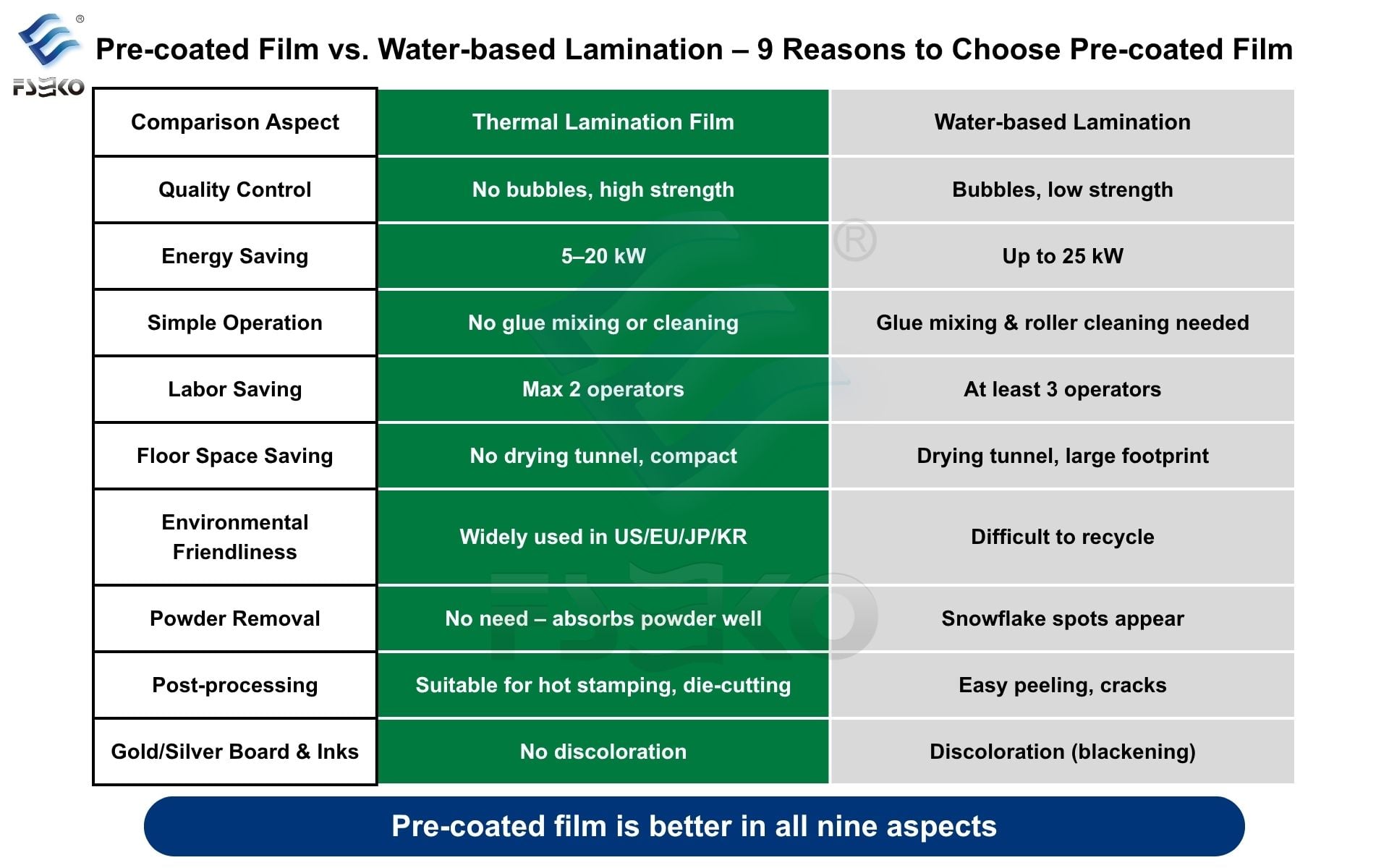
In the printing lamination industry, thermal lamination film and water-based lamination are two mainstream processes. Many companies face a choice: which is more efficient, economical, and environmentally friendly? This article compares them from nine key dimensions to help you make an informed decision.
I. Quality Control: Pre-coated Film is More Stable
Thermal lamination film uses solid EVA hot melt adhesive, eliminating the need for solvents and fundamentally avoiding the risk of bubbles. This results in high lamination strength and consistent quality.
Water-based lamination relies on water evaporation; if drying is incomplete, bubbles are easily generated, leading to decreased lamination strength. For orders requiring high-quality and stable results, pre-coated film is clearly superior.
II. Energy Saving: Pre-coated Film Halves Energy Consumption
Comparison of total equipment power:
Semi-automatic pre-coated film laminating machines require only 5-10KW, and fully automatic models do not exceed 20KW; while bridge-type semi-automatic water-based laminating machines consume up to 25KW.
Pre-coated film equipment consumes at most half the power of water-based equipment, resulting in significant long-term electricity savings.
III. Simple Operation: Pre-coated film eliminates cumbersome steps.
The pre-coating process requires no glue mixing, no glue quantity control, and no cleaning of the coating rollers, significantly reducing auxiliary time and reliance on skilled operators.
Water-based lamination, on the other hand, requires skilled workers to constantly adjust the glue ratio and application amount, making the operation complex and time-consuming.
IV. Labor Savings: Pre-coated film requires fewer workers.
A semi-automatic pre-coated film laminating machine with automatic sheet cutting requires a maximum of two operators.
Water-based laminating machines, however, require at least three operators (for feeding, gluing, and paper collection).
Based on average annual salary, pre-coated film can save tens to hundreds of thousands of US dollars in labor costs annually.
V. Space Savings: Pre-coated film requires less floor space.
Pre-coated film laminating equipment eliminates the need for drying tunnels, has a compact structure, and occupies only half the floor space of water-based equipment of the same size. It also eliminates the need for warehouse storage of glue barrels, saving valuable land rent and storage costs. This advantage is particularly significant in areas with high factory rents.
VI. Environmental Impact: Pre-coated Film Offers Higher Environmental Qualities
EVA hot melt adhesive is internationally recognized as a more environmentally friendly product than water-based adhesives. Actual application data shows that 100% of products in the US use pre-coated film, over 90% in Europe, and 70% in Japan and South Korea.
VII. No Powder Removal Required: Pre-coated Film Offers Greater Adaptability
EVA hot melt adhesive is a highly fluid and penetrating solid resin that can effectively absorb powder from printed surfaces, preventing snowflake-like spots.
Water-based adhesives, when used with printed materials with high powder content (especially large-area solid printing), are prone to producing white spots or snowflake-like spots, affecting aesthetics.
Therefore, pre-coated film is more suitable for handling printed materials with high powder content.
VIII. Flexible Post-Processing: Pre-coated Film is More Suitable for Complex Processes
Thermal lamination film has strong adhesion and high surface tension, performing excellently in post-processing such as spot varnishing, hot stamping, die-cutting, and creasing.
Water-based lamination has low surface tension, making it prone to problems like foil flaking and crease bursting during subsequent processing.
Therefore, for products with complex post-processing requirements, pre-coated film is the superior choice.
IX. Gold and Silver Cardboard and Spot Color Printing: Pre-coated Film Eliminates Discoloration Risk
Pre-coated film's EVA hot melt adhesive has high chemical inertness and does not react adversely with metallic components, maintaining vibrant colors for a long time.
The chemical components in water-based adhesives can easily react with the copper and aluminum components in gold and silver cardboard and spot color inks, causing the printed materials to discolor and turn black after several months.
Conclusion
Based on a comprehensive comparison across nine dimensions - quality stability, energy consumption, labor, space, environmental protection, and post-processing adaptability - pre-coated film technology is comprehensively superior to water-based lamination technology.
Guangdong EKO Film Manufacture Co., Ltd. has long been focused on the research and development and production of high-quality BOPP/PET thermal lamination film, digital super sticky thermal lamination film, thermal lamination film for inkjet printing, soft touch thermal lamination film, etc., providing stable, environmentally friendly, and efficient lamination solutions to global customers.