EN
EN



BOPP Thermal Lamination Film vs. PET Thermal Lamination Film: Which Should You Choose?
May.28.2026
Among pre-coated film, BOPP and PET are two of the most commonly used substrates. Many customers ask: What are the differences between them? Which one should I choose? This article helps you make the right choice from three dimensions: performance, applicable scenarios, and cost.
BOPP (Biaxially Oriented Polypropylene) is the most mainstream substrate for thermal lamination film, offering high cost-effectiveness and a wide range of applications.
Features:
Good transparency (over 90%)
Soft texture, good feel after lamination
Relatively high heat shrinkage rate
Economical price
Advantages:
Low cost, suitable for large-volume regular orders
Smooth surface and good gloss after lamination
Suitable for book covers, color boxes, flyers, etc.
Disadvantages:
Moderate heat resistance
Higher risk of edge curling than PET (especially thin paper)
Poor scratch resistance (uncoated)
Slightly lower transparency than PET
Applicable Scenarios:
Book, brochure, and magazine covers
General packaging color boxes (food, daily chemicals)
Advertising flyers and tote bags
Cost-sensitive regular orders
PET (polyester) is a superior substrate with high strength, good heat resistance, and higher transparency, suitable for high-requirement applications.
Features:
High mechanical strength (tensile and tear resistance)
Very low heat shrinkage (not prone to curling)
Good heat resistance (can withstand high-temperature post-processing)
Superior transparency to BOPP
Higher price than BOPP
Advantages:
Good dimensional stability, almost no curling after lamination
High temperature resistance, suitable for hot stamping and high-temperature die-cutting
Higher surface hardness (relatively more scratch-resistant)
Good barrier properties (moisture-proof and oil-proof)
Higher transparency, better display effect
Disadvantages:
Significantly higher cost than BOPP
Harder texture, less soft to the touch than BOPP
Suitable Scenarios:
Printed products requiring high-temperature post-processing (hot stamping, embossing)
Products requiring high dimensional stability (such as precision packaging)
Packaging requiring high scratch and wear resistance
High-end electronic product packaging, cosmetic gift boxes
Food packaging requiring moisture and oil resistance
Exquisite brochures and luxury packaging requiring extremely high transparency
III. Quick Comparison: BOPP vs. PET
Aspect |
||
Cost |
Economical |
Higher |
Transparency |
Good |
Better |
Softness |
Soft, pleasant feel |
Stiffer, crisper feel |
Heat shrinkage |
Higher |
Low |
Heat resistance |
Moderate |
Excellent |
Post-processing suitability |
Basic hot stamping, die-cutting |
High-temperature hot stamping, precision die-cutting |
Typical applications |
Books, standard cartons, ads |
High-end packaging, electronics, heat-resistant jobs, clarity-critical jobs |
IV. How to Choose?
Choose BOPP pre-coated film if:
Limited budget, seeking high cost-effectiveness
Low requirements for post-processing temperature (ordinary hot stamping, die-cutting)
Medium paper thickness, not prone to curling
Regular books, color boxes, promotional materials
No extreme requirements for transparency
Choose PET pre-coated film if:
Requires high-temperature hot stamping or complex post-processing
Very thin paper or high humidity environment, concerned about curling
Requires scratch and wear resistance for packagingRequires higher transparency and display effect
High-end products, budget allows
Summary
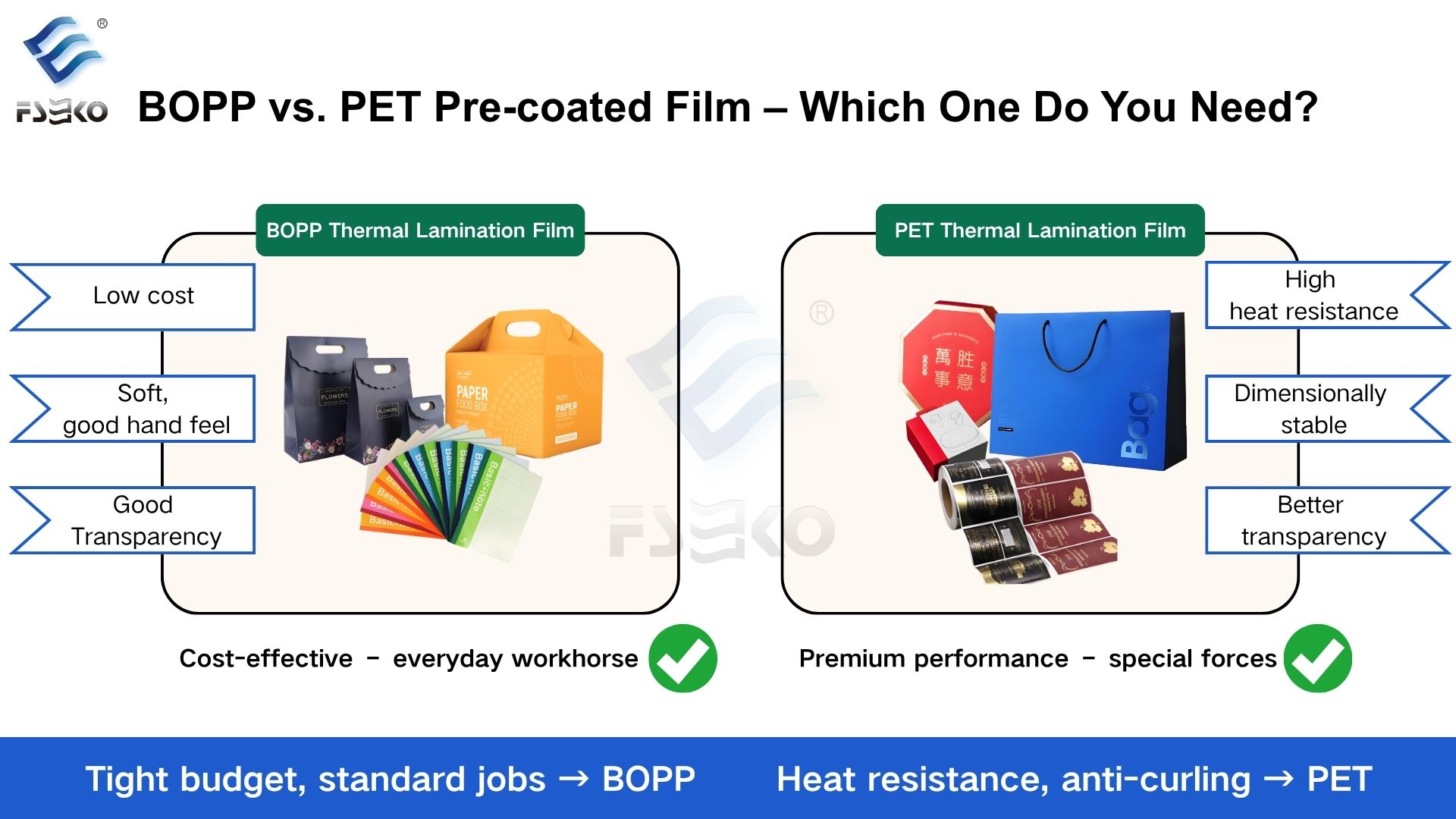
BOPP is the "everyday mainstay," suitable for most regular orders, offering high cost-effectiveness; PET is the "special forces," specifically designed to solve problems such as high temperature, curling, and scratch resistance, while providing superior transparency.
Guangdong EKO Film Manufacture Co., Ltd. also provides high-quality BOPP and PET thermal lamination film, including glossy, matte, scratch-resistant, and tactile products. For selection advice or samples, please contact us.