 EN


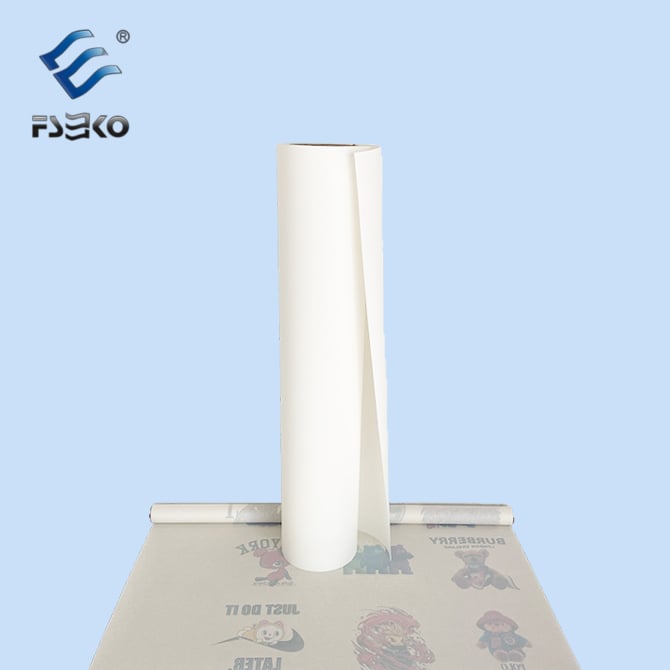
Two films can both carry the word clear on the label and look identical on the roll, then behave completely differently once they sit on a printed sheet under a store's lighting. One disappears into the image. The other leaves a faint milkiness that turns a rich black into a soft charcoal and gives a white background a gray cast nobody asked for. That gap is not a quality control slip at the converter. It is the difference between a base film engineered for optical performance and a commodity film that simply happens to be transparent.
Clarity in a thermal laminate comes from how little the material scatters light. Scattering is driven by crystallinity, surface roughness, and the additive package used to keep the film from blocking on the roll. Slip agents and antiblock particles do their job at the winding stage, but they also bump up haze. A film formulator has to trade those properties off against each other, and the trade-off is where clear PET thermal lamination film separates itself from the pile.
What a Polyester Base Actually Brings
Biaxially oriented polypropylene has been the workhorse of thermal lamination for decades, and for plenty of jobs it still makes sense. Polyester, though, brings a different set of mechanical properties to the same process. PET has noticeably higher tensile strength at the same gauge, a higher softening point, and much better dimensional stability under heat and tension.
That matters more than it first appears. A laminate that creeps or stretches slightly under the nip tends to show registration drift on a tight die-cut, and it can curl when a sheet goes through a laser printer or a hot foil stamping unit downstream. Polyester holds its dimensions through those steps. The higher heat resistance also buys headroom in the lamination window itself, so the adhesive can be brought to full flow without the carrier film starting to soften or distort. BOPP, being softer and more elastic, is more forgiving on tight curves but less stable when the job demands precision and thermal durability.
There is a handling angle too. PET is stiffer, so it feeds more predictably through automatic sheet laminators and lays flatter on the pile. On very thin paper stocks the extra stiffness can work against you, which is a limitation worth naming up front, but on carton board, covers, and signage substrates the rigidity is usually an asset.
The Optical Numbers That Separate a Good Film from a Great One
Haze and gloss are the two measurable values that predict how a laminate will look on press output. Haze measures the percentage of light scattered rather than transmitted straight through. Gloss measures how much light reflects off the surface at a defined angle. Both have standardized test methods, and both can be requested from a supplier as a documented number.
| Optical and Physical Marker | Standard Clear Film | High-Clarity PET Film |
|---|---|---|
| Haze, typical measured value | Higher, often noticeable on black solids | Engineered lower, image stays crisp |
| Surface gloss, 45 degree reading | Moderate | Higher, more depth on photographic work |
| Dimensional stability under heat | Can stretch or curl | Holds through hot downstream steps |
| Behavior on tight die-cut registration | Some drift possible | More predictable registration |
| Stiffness and lay-flat on the pile | Softer, more conformable | Stiffer, feeds cleanly on sheet lines |
| Cost per roll | Lower | Higher, offset by appearance and yield |
The gloss reading is the one that gets overlooked most often. A low-haze film with a dull surface still looks flat, especially on dark imagery where the difference between a deep black and a washed-out one is largely a function of surface reflectance. High-clarity polyester with a well-controlled surface finish gives photographic prints and premium packaging that wet, saturated look that customers respond to without being able to explain why.
A Display Graphics Shop Where Haze Turned into a Complaint
A shop producing backlit retail graphics ran a recurring issue on a menu board program. The panels were printed with a white ink base and a dense dark background, then laminated with a clear thermal film that had been used on general signage work for years. On the wall under office lighting, the panels looked acceptable. Backlit in the customer's fixtures, the dark areas read gray and the white areas looked dingy, and the client sent two rounds back.
The film was not defective and the press was in calibration. The issue was haze plus the way a white ink base reflects light through the laminate. The scattered light came back through the image, lifting the blacks and dulling the whites. The fix was to move to a low-haze polyester laminate with documented optical values, verify the activation temperature against the shop's laminator, and confirm the bond on a small run before committing the full program. The replacement film measured within a tight haze tolerance, and the gray cast disappeared. Nothing else in the workflow changed. The lesson was that on backlit and high-contrast work, clarity is a specification, not an aesthetic preference.
Where the Extra Clarity Pays Off and Where It Does Not
Clear PET earns its cost on work where the image is the product and any visual compromise is visible to the buyer. Photographic prints, premium retail packaging, book covers, presentation folders, and backlit or high-contrast signage all benefit. So do jobs that see downstream heat, such as pieces that go through a laser printer after lamination or a hot foil step, where the polyester base holds up better than a softer polypropylene carrier.
Honest limits exist. Polyester film costs more than standard BOPP, and on a long-run job where appearance tolerances are loose, that premium may not return anything the customer can see. The extra stiffness that helps on carton board can cause curling on very thin text stocks, and on substrates with tight compound curves, a more conformable film is often the better call. Adhesion still depends on matching the adhesive to the print surface, so a high-clarity film paired with the wrong activation temperature will disappoint regardless of how good its optical values are. Clarity is one variable among several, not a substitute for the rest.
Specifying Clarity with a Number Instead of a Promise
Two test methods are worth asking about directly. ASTM D1003 covers haze and luminous transmittance for transparent plastics, and ASTM D2457 covers specular gloss for plastic film. A supplier that can quote results from those methods, along with the thickness and treatment details, is giving a production team something to compare across candidates.
Surface treatment deserves a mention as well. A properly treated PET surface takes ink, adhesive, and UV coating more reliably, which affects both the bond and the appearance of any post-lamination printing. Activation range is the other value to pin down, because the adhesive must reach full flow without pushing the film past the point where it starts to distort.
Guangdong EKO Film Manufacture Co., Ltd. has spent over nineteen years developing pre-coated film systems, with a clear PET thermal lamination line built around measured optical performance rather than a general claim of transparency. The operation runs ISO 9001 quality controls across a 6,000-ton annual capacity and supplies converters in more than one hundred countries, which means the film leaving the line has been specified against the same optical and mechanical standards that finishing floors apply on incoming inspection. For a shop that has argued with a customer about why a black looked gray, that kind of documented consistency is worth paying attention to.