 EN
EN


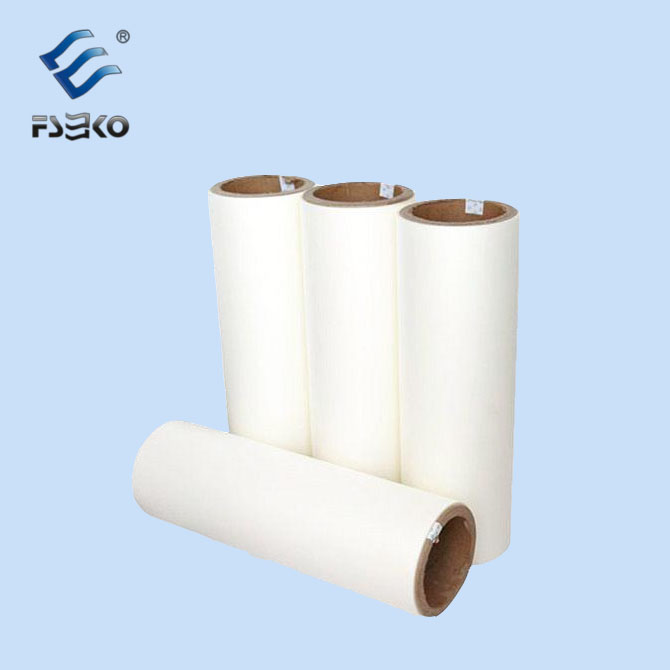
Speed and Quality Don't Have to Be Opposites
Conventional wisdom in finishing departments has long held that running lamination faster means accepting more defects. Slower speeds give the adhesive more dwell time under heat and pressure. Faster speeds risk incomplete bonding, bubbling, and edge lift. This trade-off has been accepted as fact for decades.
The assumption is outdated.
Modern high-speed lamination equipment paired with properly formulated film can run at speeds that would have been unthinkable fifteen years ago while maintaining defect rates that older machines couldn't achieve even at half the speed. The difference comes down to film formulation and process control rather than the machine alone.
The Thermal Budget Concept
Every lamination process operates within a thermal budget—the combination of temperature, pressure, and dwell time required to activate the adhesive and form a permanent bond. High-speed lamination reduces dwell time, which means the system must compensate through precise temperature control and adhesive chemistry that activates quickly and completely.
Films designed for high-speed applications use modified EVA or acrylic formulations with lower activation temperatures and faster wet-out characteristics. The adhesive flows and bonds within a shorter time window without requiring excessive heat that could damage the substrate or ink layer. This is the technical foundation that makes high-speed lamination viable.
The practical implication is that speed becomes a variable that can be optimized rather than a constraint that limits quality. Operations running high-speed equipment can maintain throughput without sacrificing bond integrity, provided the film specification matches the equipment capabilities.
What Actually Goes Wrong at Speed
Understanding failure modes at high speed helps explain why film quality becomes more critical as production rates increase.
Adhesive starvation occurs when the film doesn't deliver enough adhesive to the substrate within the shortened dwell time. The bond forms incompletely, and delamination shows up days or weeks later. This failure mode is almost always caused by insufficient coating weight or adhesive that requires more time to wet out than the speed allows.
Heat transfer becomes uneven at higher speeds because the substrate and film have less time to reach thermal equilibrium. Areas with higher ink coverage or denser substrates absorb heat differently, creating temperature gradients across the web. The result shows up as inconsistent gloss or patchy adhesion in high-coverage areas.
Static buildup intensifies at higher speeds. The friction between film and equipment generates electrostatic charge that attracts dust, causes film wandering, and can even create visible discharge marks on the finished surface. Quality films incorporate anti-static additives that mitigate this effect, but commodity films often skip this step to reduce cost.
Wrinkling becomes more likely at speed because the film has less time to conform to the substrate surface. Any variation in film flatness or tension control shows up as creases that ruin the finished piece. Films with consistent thickness and uniform winding tension handle high-speed runs without this problem.
A Production Manager's Discovery
A commercial printer in the Midwest running a 40-inch automated laminator had been capping their production speed at around 40 feet per minute to maintain acceptable quality. Any faster and the reject rate climbed from 2% to nearly 7%, making the speed increase uneconomical.
The production manager tested a thermal precoated film from a different source—same thickness rating, same finish—without changing any machine settings. The new film ran cleanly at 55 feet per minute with a reject rate below 1.5% across a two-week trial covering several substrate types and ink densities.
The difference wasn't the machine or the operator technique. It was the film's adhesive formulation and coating consistency. The original film had been borderline acceptable at lower speeds but couldn't handle the thermal and mechanical demands of higher throughput. The new film was engineered for exactly that operating range.
The shop increased its lamination throughput by nearly 40% without adding equipment or staff, simply by switching to a film that matched the machine's capability.
Quality Control Metrics That Scale with Speed
Quality control in high-speed lamination requires different metrics than slower operations. Traditional visual inspection becomes less reliable because defects appear and disappear too quickly for human eyes to catch.
| QC Metric | At Low Speed (≤30 ft/min) | At High Speed (≥50 ft/min) |
|---|---|---|
| Visual inspection effectiveness | Moderate—operator can catch most defects | Low—defects often missed |
| Adhesive bond testing | Destructive testing per roll | In-line peel force monitoring preferred |
| Thickness variation tolerance | ±5 microns acceptable | ±2 microns required |
| Static control requirement | Optional | Essential |
| Temperature stability tolerance | ±5°C acceptable | ±2°C required |
The shift to high-speed operation demands tighter tolerances across every variable. Film thickness variation that was acceptable at low speed becomes a problem at high speed because the reduced dwell time leaves less margin for error. Temperature control that was adequate becomes insufficient because heat transfer needs to be more precise.
Why High-Speed Capability Indicates Manufacturing Sophistication
A manufacturer's ability to produce film that performs reliably at high speed reveals a lot about their production capabilities. Consistent high-speed performance requires:
Tight process control across the entire coating line. Variations in coating weight that would be acceptable for slower applications become unacceptable at high speed because the adhesive has less time to flow and bond.
Rigorous raw material selection. Adhesive formulations for high-speed applications require specific resin grades and additive packages. Substituting lower-cost alternatives changes the thermal and flow characteristics in ways that show up at speed.
Comprehensive quality testing. Manufacturers who supply high-speed applications typically run in-line thickness monitoring, adhesive weight verification, and peel strength testing as standard practice. These tests catch variability before it reaches the customer.
The companies that can deliver consistent high-speed performance have invested in the production infrastructure and quality systems that make it possible. This is not an area where shortcuts work.
The Real Constraint Isn't Speed
The limiting factor in high-speed lamination is rarely the equipment itself. Modern laminators are capable of running at speeds that outpace most shops' material handling and workflow. The constraint is almost always the film.
Shops that have optimized their lamination workflow around high-quality film find that they can run faster, with fewer rejects, and with less operator intervention. The speed becomes an advantage rather than a risk. The equipment runs closer to its rated capacity, and the finishing department stops being the bottleneck in the production schedule.
Manufacturers who understand this dynamic design their films with high-speed operation in mind. The adhesive chemistry, coating process, and quality control protocols all support consistent performance across a wide speed range. This is the kind of engineering that doesn't show up on the spec sheet but makes a measurable difference on the production floor.
Guangdong EKO Film Manufacture Co., Ltd. has oriented its production capabilities around this reality. With over two decades of manufacturing experience, the company's process controls and quality systems are built to deliver film that performs consistently whether the line is running at moderate speeds or pushing the upper limits of the equipment. The focus on coating uniformity and adhesive stability reflects an understanding that high-speed capability isn't a marketing claim—it's a manufacturing discipline.